

































































Recent transparency concerns cast uncertainty on Lafayette College’s budget planning committee, which works to guide the college’s financial planning and strategy. The committee, described by one faculty member as “way too many meetings for very little impact,” was on the chopping block at the April 28 faculty meeting.
But faculty voted down a motion that would symbolically eliminate the committee; the vote was 50-58, with 26 abstentions, according to Clerk of the Faculty Joshua Smith. Despite that, a new operations committee intended to improve shared governance passed overwhelmingly.
A vote to dissolve the budget committee coincided with two motions proposed by a committee handling the faculty’s internal governance: the first, a motion to approve the “Strategy, Policy and Operations Committee,” passed 109-21. A second motion, to disband the faculty’s “Advocacy and Coordination Council,” passed 112-13; the council formed in 2022 and organized meetings for chairs of various committees.
“We’ve had a lot of stuff on the docket lately that might seem like inside baseball, but it’s kind of consequential decisions that folks are making,” said international affairs professor Caleb Gallemore, who provided comments in favor of the operations committee at the meeting.
Psychology professor Michael Nees wrote in an email that he disagreed with “an emotion-based plea” during the meeting that suggested anyone who voted to remove the college budget planning committee “was voting to harm our non-faculty colleagues.” He ultimately voted to dissolve the committee.
Nees worked on a 152-page report compiled by the college’s ad hoc committee for financial stewardship and accountability in 2024; the report found roughly two-thirds of survey respondents disagreed with a statement that the college “clearly communicates budgetary priorities for the institution.”
Economics professor James DeVault, who currently serves on the budget committee, declined to comment.
A faculty motion to dissolve the budget planning committee was recommended as a “service of iterating towards a more effective faculty governance structure,” according to a copy obtained by The Lafayette.
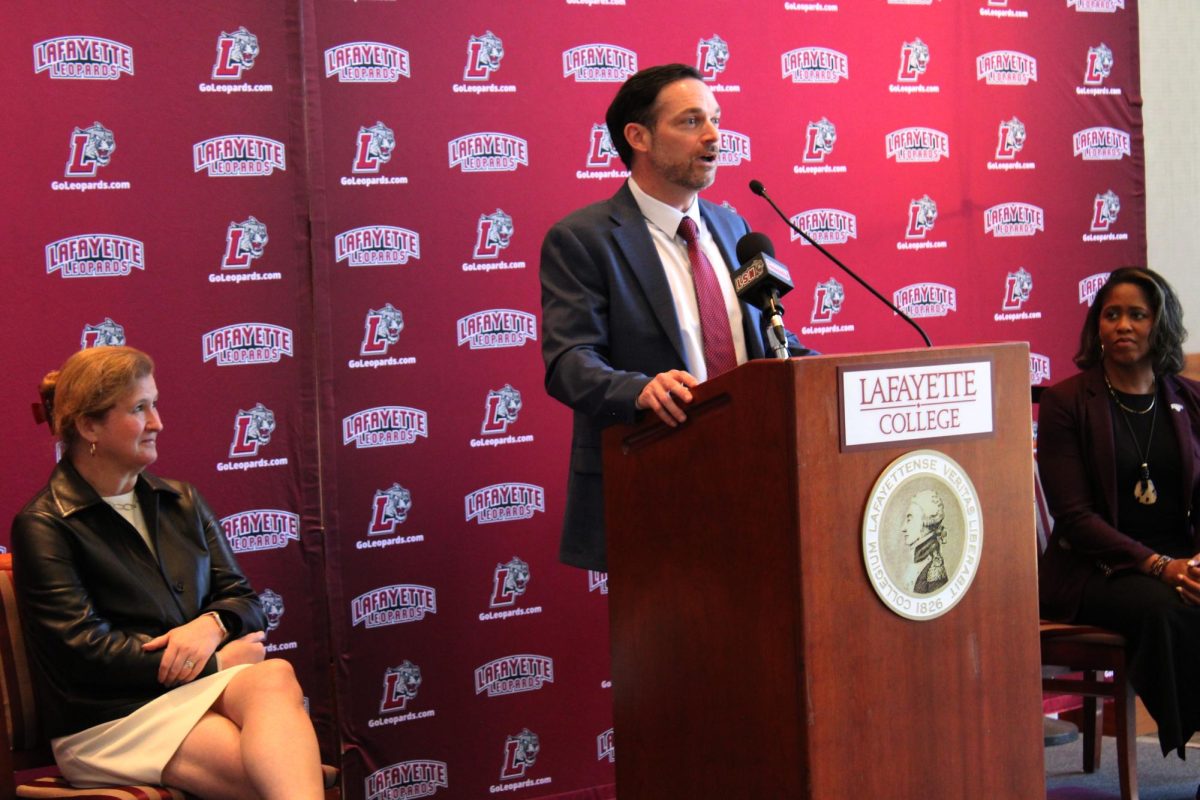
Vice President for Finance and Administration Audra Kahr wrote in a statement that college President Nicole Hurd is “reviewing feedback received from numerous sources—committee members, faculty, and Administrative Council.”
“I’ve got a lot of data points that I need to know, take under consideration and I will spend some time thinking about what the future of that committee will look like,” Hurd said.
Neither Kahr nor Provost Laura McGrane, who praised the governance committee’s work in planning the operations committee in a statement, responded to specific questions.
The responsibilities of the operations committee are to “work with and render its advice to the President and the Provost on all significant matters of concern to the Faculty that affect the life of the College,” according to the approved motion for the committee.
Gallemore thought the operations committee would resemble a defunct faculty academic policy committee, which was made up of faculty across different departments making decisions about college governance. He voted to maintain the budget committee, describing working in the group as “a complicated task.”
Psychology professor Abbey Mann wrote in an email that she was proud of the faculty for “putting forth a motion aimed at addressing many of the needs and issues” frequently discussed in recent years — issues which included a successful no-confidence vote against Hurd in 2025. Mann spoke in favor of the new committee at the meeting.

Just the Facts • May 18, 2026 at 6:09 pm
Anti-Forrest Gump, I am afraid these folks don’t have the smarts to understand 10% of what you are saying. One thinks tenure at Lafayette is a good behavior contest and is so clueless about higher ed he does not even know what the social sciences are (STEM good. Humanities bad. Point. Grunt.). And, even though this year’s Commencement speaker (who will be honored with nothing less than a Lafayette degree) is a hard-core right-winger who literally wrote a book called the “The Conservative Heart” and also ran a right-wing think tank for a decade, the other one spouts dog whistle nonsense about DEI indoctrination. Looks to me like the indoctrination is running hard in the other direction and coming straight from the top. Shame on President Hurd and the Board for so explicitly endorsing a political side when Lafayette should be non-partisan, especially at graduation.
Higher Ed Betty • Jun 5, 2026 at 3:05 pm
One of the more revealing features of this debate over higher education is how quickly critics of colleges and universities are dismissed as stupid, reactionary, or captive to cable-news caricature. That response may be emotionally satisfying, but it is intellectually lazy. More importantly, it is part of the problem.
Many people who worry about higher education are not hostile to learning. They are parents, alumni, taxpayers, employers, students, faculty members, trustees, and graduates who believe deeply in learning and are saddened to see public confidence in higher education decline. They worry not because they despise education, but because education is too important to be excused from scrutiny.
The erosion of trust is real. Gallup and Lumina report that public confidence in higher education has fallen sharply over the past decade, while Pew has found that seven in ten Americans now say the system is headed in the wrong direction. This is not simply a right-wing fever dream. It is a broad civic warning.
The reasons are not imaginary. Families worry about cost, debt, and whether a degree still delivers what colleges promise. Others worry about intellectual conformity, uneven standards, administrative growth, and the difficulty of sustaining genuine inquiry in a polarized culture. These concerns do not require hostility to the humanities or social sciences. They often come from people who love those fields and want them to recover their authority.
That is why Vanderbilt University’s 2026 Special Commission Report on the State of Scholarship in the Humanities and the Humanistic Social Sciences is useful. It does not say that the humanities or social sciences are worthless. It says the opposite: they matter profoundly. But because they matter, they must be governed by evidence, rigor, openness to disagreement, and standards that are intellectual rather than ideological. Its discussion of anthropology is especially notable because it shows how a field devoted to understanding human difference can lose public trust when scholarship appears to become advocacy first and inquiry second.
This does not mean that professors should be forbidden from studying race, inequality, gender, or power. They should be free to do so, and serious scholarship on those subjects is indispensable. But higher education should be cautious about elevating work that treats DEI commitments, political activism, or prescribed ethical conclusions as substitutes for inquiry itself. When institutions appear to reward partisan conformity rather than intellectual excellence, they should not be surprised when the public questions their neutrality.
Colleges should be nonpartisan, but nonpartisanship does not mean insulating higher education from criticism. It means refusing to reduce every disagreement to tribal loyalty. Here Lafayette has an opportunity to stand out and not fall in line with partisanship that has eroded trust in higher education.
Abbey Mann • May 8, 2026 at 12:09 pm
I would like to clarify that I did not mention the no-confidence vote in response to the request for my comment about this story.
Paul Young • May 11, 2026 at 6:08 pm
Prof. Mann is a Psych prof without tenure. She is from Philly and Lafayette is a dream job for her. She is very well qualified. She is coming from “East Tennessee State University” (yuck) and would be a great match for Lafayette. Unlike the tenured profs she does not want to offend the administration. Let the record show that when she comes up for tenure at least one Pard friend (me) sees her as well deserving of tenure. It takes a of guts for a prof to stand up – in even as subtle a way as she just did – in the student newspaper!
Tinker, Tailor, Soldier, Spy • May 13, 2026 at 8:50 pm
It’s simple! If you’re a simpleton.
Go Bucs • May 16, 2026 at 7:41 am
East Tennessee State University is a solid regional public university, especially for a practical, affordable education. Meanwhile, Prof. Mann’s teaching philosophy aims to “foster social justice” and “use feminist pedagogy, which prioritizes the examination of race, class, and gender.” A great match indeed for a mid-tier private college that charges $90k tuition for DEI indoctrination.
Paul Young • May 18, 2026 at 11:01 am
Cosi fan tutte
The Anti-Forrest Gump • May 18, 2026 at 1:43 pm
For the simpleton crew who apparently couldn’t bother to look up where Professor Mann did her Ph.D. (Vanderbilt), I am wondering what you imagine the social sciences to be if not about race, class, and gender. These categories of analysis have been the staple categories of sociology, psychology, and anthropology since the inception of these disciplines as disciplines (long before Fox News equipped you chuckleheads with anti-intellectual talking points and terms like “woke,” “DEI,” or “cultural Marxism”). If an economist teaches a course on women and the economy and presents empirical data on salary differences between men and women, is that DEI indoctrination? Sociology as imagined by many of its founders like Emile Durkheim, imagined it to be a form of secular religion in France that he hoped could improve social life against the corrosiveness of role specialization under capitalism (he lived through the booms and busts of the French textile industry). Please read a book. “Social justice” was baked into the DNA of many disciplines from the 19th century onward.