







































By Ryan McNeill & Anda Totoreanu
Photo by Steve Tringali/ The Lafayette
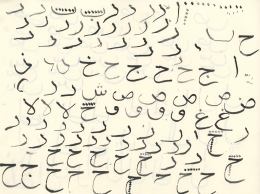
You don’t have to be a scholar of Muslim or Arabic culture to appreciate the winding curls and delicate movements found in the work of Islamic calligraphers. Last Friday, students were treated to the opportunity to attend a lecture and workshop on the history and techniques surrounding this unique art form, delivered by ElinorAishah Holland, an American-born expert in the field of calligraphy.
“Looking at calligraphy across time and different geographical regions gives insight into the cultural development of Islam,” Professor of Religious Studies Asma Sayeed said.
Sayeed coordinated the lecture and workshop as part of the curriculum for her course, Religion 207: The Quran, an in-depth study of the Islamic text. The event was sponsored by the Lyman Coleman Fund-Department of Religious Studies and the Muslim Students Association.
Holland recounted the history of Islamic calligraphy, beginning with archaic styles such as Kufic, then working her way to styles of calligraphy still practiced today.
Holland began the lecture by requesting that the lights of Oeschle Hall’s auditorium be turned off “so the rest of the room can relax,” she said. This idea seemed to capture the mood of her presentation, which was her fourth or fifth to Lafayette’s campus.
Lafayette students and faculty were able to try their hands at calligraphy in the workshop under Holland’s expertise. Each participant was given his or her own qulam (a pen made of the traditional bamboo or reeds that Holland had sharpened for each student), an inkwell and a sheet of specially prepared paper. Holland instructed the students on proper technique, such as how to dip into one’s inkwell and how to create the proper spacing within each letter. The participants were encouraged to attempt to copy or transcribe letters from the Arabic alphabet.
Traditional calligraphy students go through the grueling process of copying and recopying letters over and over again. That is why beginners are taught to internalize the chant, “Lord make it easy, and do not make it difficult. Lord let it end ingoodness.”
According to Holland, Calligraphy is done very slowly. “It takes a lot of time and patience, and it takes attention to detail and a bit of being obsessive.” She has devoted her life to the study and although she is recognized as one of the top calligraphers in the Western world, she has yet to receive her Ijaza, the degree that would officially license her as a master of the art form. “I’m not an academic. I’m an artist and I enjoy calligraphy,” Holland said.
During the workshop, some students struggled with the art form.
“I expected it to be really bad,” Kadija Hafiz ‘12 said of her expectations for her own calligraphy. Hafiz was already familiar with the Arabic alphabet, but stressed that she never realized how much work and detail goes into it “even just in the way you hold the pen!”
Another student, Andy Moore ’12 said “I already have really bad handwriting in English… the hardest part about the whole thing is using this new writing instrument.”
Despite finding the work difficult, Moore was able to appreciate the connection it had to his study of Islamic history. “In class, we look at different styles and different passages in the Quran. Calligraphy relates to how the Quran is written, so it all fits together.”