


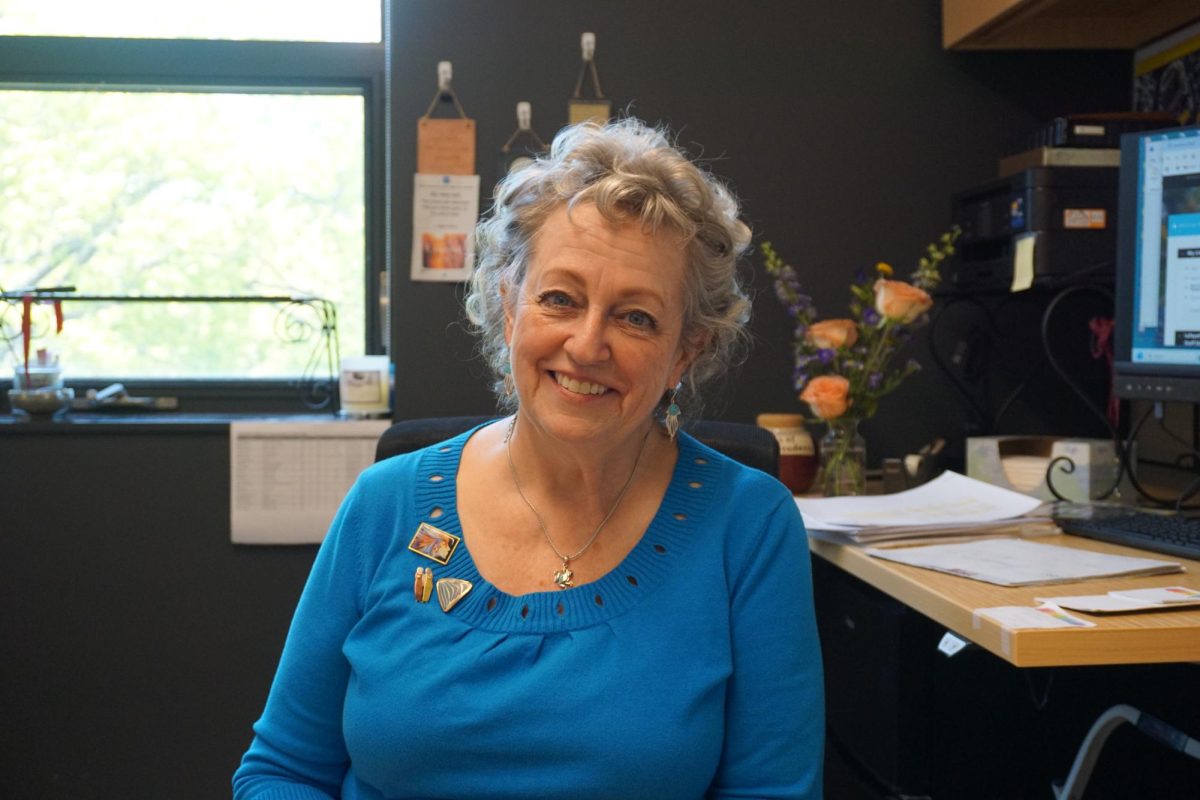






























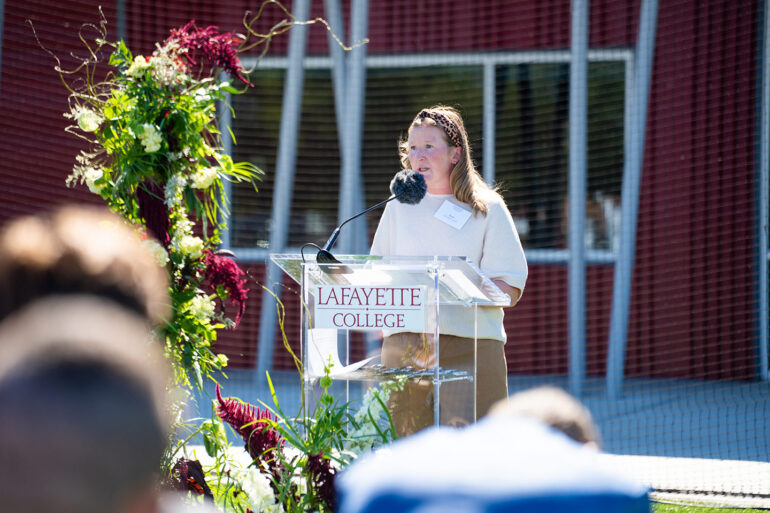


















When Kirsten Ziomek, a history professor at Adelphi University, began her research on World War II in China and the Pacific, she did not expect to find women as such a significant part of its history.
“I thought, yeah, this is about men,” Ziomek said during her talk in Skillman Library last Thursday to an audience of around 60 students and faculty. “As historians, however, you follow where the evidence is, and the evidence kept driving me towards finding dead female bodies.”
The talk, hosted by the history and Women’s, Gender and Sexuality Studies departments, explored the intense and neglected history of women forced into sexual slavery by the Japanese military, and the evidence found to suggest that these women were participating in active combat.
She began by explaining the terminology used by the military and historians: “comfort women” are women sexually trafficked by soldiers in bases referred to as “comfort stations.”
“In Japan, traditional narratives posit women in two oppositional ways,” Ziomek said. Many were portrayed as innocent and devoted, while “comfort women” were depicted simply as victims of sexual violence, with that idea leaving little room to conceptualize women as active participants in the military.
She explained that this term has been retired by activists, who use “sex slave” to more clearly demonstrate the nature of the role into which these women were forced.
By confronting the assumption that there is only a “male military,” Ziomek highlighted persisting gaps in historical knowledge.
“It’s something that a lot of Americans aren’t aware of,” said Preston Bean ‘26, an Asian Studies student.
College archivist Elaine Stomber, meanwhile, found it particularly fascinating that the speaker incorporated historical photographs of women.

For her project, Ziomek visited a war museum in Tokyo, where she found thousands of portraits memorializing male soldiers, with women’s portraits strewn about. This prompted further investigation, leading to evidence suggesting that many comfort women had previously been resistance fighters or were coerced into supporting military efforts.
Ziomek made clear that acknowledging these roles does not minimize the sexual violence these women endured. Rather, it broadens historical understanding by recognizing that these women were far more complex than having their identities reduced to a single narrative.
“We can find unexpected narratives if you start with a question, and you go back sincerely, and go through the records,” Ziomek said after the lecture. “There are ways to write new histories.”
History professor Paul Barclay noted the unique political context of the speech, and that while operating in a polarized political environment, “anything that we do that is evidence-based and where we’re trying to tell the truth is a kind of activism.”