

































Lafayette College’s campus has seen its fair share of protests, from protesting the Vietnam War to more recent demonstrations in response to the Israel-Palestine conflict. However, this academic year has been relatively quiet with a downtown Easton protest having taken place in March, in which a handful of Lafayette students were present.
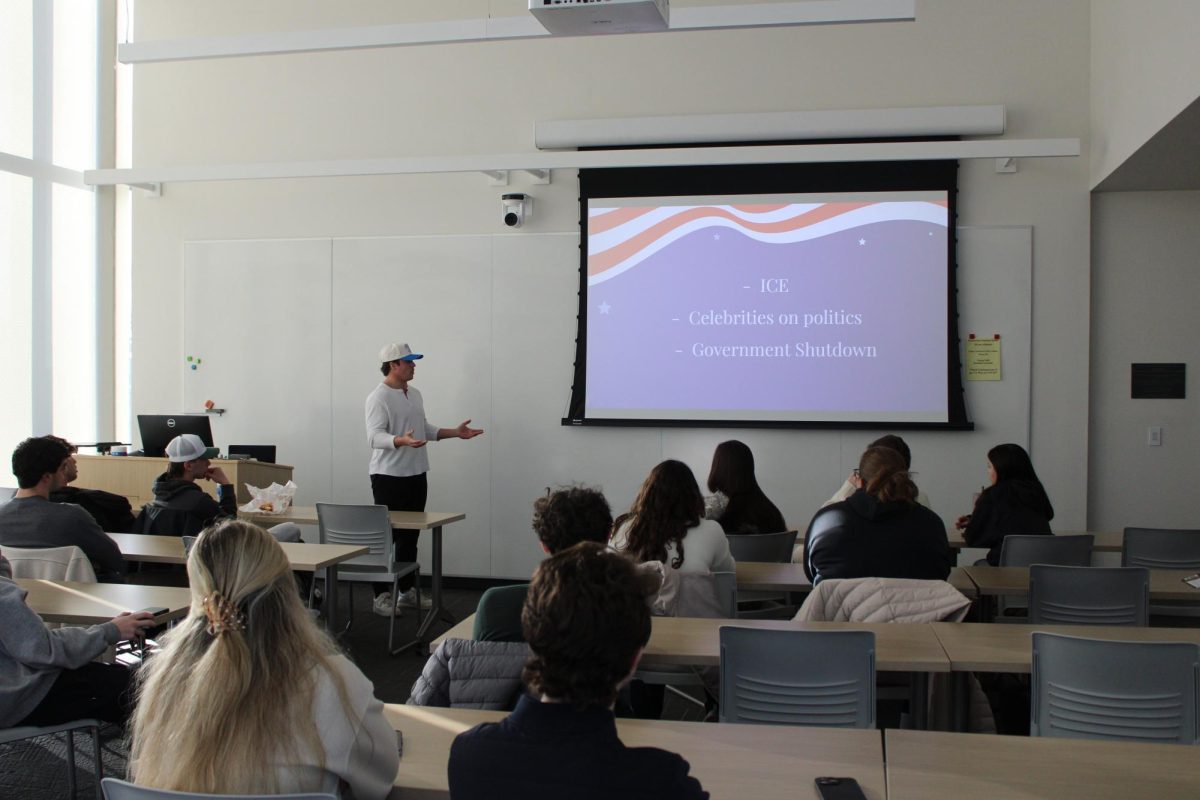
“I feel like people are just more reticent to speak about politics, like, at all here, as opposed to being loud and proud about it,” said Jack Maloney ‘25, the president of the Lafayette College Democrats.
Maloney and other members of the Lafayette College Democrats have made efforts to engage students in political action, including promoting attendance at the aforementioned Easton protest. Despite these efforts, Maloney expressed disappointment at the turnout.
“It didn’t seem like anyone was really interested in coming down,” Maloney said.
Fatimata Cham ‘23, a former student activist and Pepper Prize winner, believes the challenge could stem from mobilizing in sufficient numbers.
“I think in general with any movement when the purpose and messaging isn’t strong, it can be difficult to follow through and feel like your voice isn’t loud enough,” Cham said.
The Lafayette took a look back at other important times in college history, when Lafayette students protested a significant college-wide or international issue.
Police brutality, World War II and co-education controversies
One of the earliest documented Lafayette protests took place in 1918, when a seemingly routine freshman parade ended in a confrontation with local police and reported police brutality towards a student. Although Easton newspapers classified the students as troublemakers deserving of punishment, The Lafayette challenged this notion and defended the students’ right to protest what it viewed as unjust treatment.
The pattern of activism continued throughout the years of World War II, and in 1940, the Student Peace Committee organized demonstrations in response to the rapidly growing international tensions. As World War II loomed, Lafayette students decided to join a nationwide movement of college peace demonstrations and peacefully protested the war.
Perhaps one of the largest and most consequential demonstrations in Lafayette’s history occurred in 1969, when approximately 750 students rallied at Markle Hall to demand that the college become co-educational. Their efforts were fruitful, and women were permitted to attend Lafayette College the following academic year.
Vietnam and a curfew policy
The surge of activism on Lafayette’s campus during the Vietnam War was significant, particularly in May 1970, when news of expanded U.S. military actions sparked nationwide campus protests.
Peter Newman ’73, a current English professor at Lafayette, experienced firsthand the political activism on campus during the Vietnam War as a student.
“Within a day or two, we voted to strike,” Newman said. “We got permission. We made arrangements with our professors and were very well supported by much of the faculty and the president.”
“That two or three-week period probably had more of an effect on me than any other time period in my life,” Newman added, reflecting on the intensity of the campus activism during that era.
The anti-war sentiment had been building throughout the 1960s, with many resisting mandatory Reserve Officers’ Training Corps, or ROTC, training in 1967. Students demonstrated by bringing water balloons to throw and disrupt ROTC ceremonies. Students for Democratic Reform, a national student activist organization, became increasingly active during this time period as the group held organized teach-ins about the draft and invited guest speakers to campus.
Student activism was not only directed towards national issues. In 1979, approximately 125 students gathered in front of Markle Hall to call for the removal of a 2 a.m. curfew policy. Protestors burned down a statue of Herman C. Kissiah, the former dean of students, and drove wagons and rolled kegs of alcohol across Lafayette’s quad.
Administrative protests and the first Trump term
At the beginning of the fall semester in 1990, a group of over 70 people gathered to demand a more active social life from the administration. The organizers claimed that the social life was not active, forcing students to go to off-campus parties that resulted in increased arrests.
Decades of smaller protests centered around student life or the international war in Iraq. Student activism increased more drastically after Trump’s first election in 2016, with students distributing over 300 “Not My President” posters overnight, and roughly 200 students walking out of class the following week.
“This is definitely an awkward time, because people, for the past few months, haven’t really known what to expect of the administration, or what exactly they’re protesting against,” Maloney said.
Government & Law professor Joshua Miller, who has taught at Lafayette since 1986, noted that the campus has historically seen periodic surges in activism around specific events, mentioning the demonstration that occurred on the quad in 2016 following Trump’s first election and an increase in student activism during the 2020 Black Lives Matter movement.
Alongside other sources cited and linked, the Lafayette College Archives was a main source of information for this article.

Doug Easterly • May 8, 2025 at 4:21 pm
Victoria great article but one error. The 2AM curfew demo and efigagy burning of still living on College Hill i found out Dean Kassiah was in early Dec 1984 not in 1989. I am 1984 grad and I wasn’t a partier but I recall hearing about it from a sophomore I knew who attended the protest. I know Chairman Sell very well also 1984 class and I’m sure he even he would agree it was a prudent move. If you’re not buzzed by 2AM shame on you. Of course I was in bed by midnight on Fri and Sat nights but I would wake Sat and Sun at 7AM and get my printed edition of Phila Inquirer ( still read it in hardcopy along with NY Times every morning yay to Michael Schmidt!) Wawa coffee and recall seeing the detritious leavings of night – or morning – along my walk to Wawa and back. Have a great summer and say YES to free press and student journalism! Kind regards Doug Easterly class of 1984 Long Beach Island NJ