










































































Energy is in full swing surrounding Lafayette College’s impending climate neutrality goal, with campus-wide sessions beginning this fall to kick off the yearlong process of revamping the college’s current plan.
This third iteration, known as Climate Action Plan 3.0, will reupdate strategies and goals for the college’s commitment to achieve carbon neutrality by 2035, with expectations for a finalized version by May 2026.
“It’s a really proud moment for us,” Sustainability Director Delicia Nahman said. “To know how far we’ve come, and envision not just how we’re going to get to our 2035 carbon neutrality commitment, but what the next 200 years look like for us.”
Since its baseline reading in 2007, the college has reduced its primary carbon emissions by 41% through efforts outlined in the original plan, which included installing solar panels, building a renewable energy wind turbine and making infrastructure more energy efficient.
Work to revise the plan officially began last spring, when the college contacted a global consulting firm to help collect data on the college’s carbon emissions, building energy usage and climate vulnerabilities across campus. A steering committee and an advisory committee composed of staff, faculty and one student were also assembled that spring.
After visiting the campus in August, the firm returned twice more this fall to present its findings to the Office of Sustainability in open listening sessions. Presentations in September centered around the vision and principles of the plan, while this week’s most recent presentations dove deeper into a breakdown of the college’s greenhouse gas emissions.
Naomi Davy, a senior associate at Environmental Resources Management, said that the firm had a team “go through about 80 buildings on campus.” She added that the team recorded observations and opportunities for reducing energy consumption, ranging from strategies like adjusting lights to replacing windows.
Davy said that the consulting firm will be “intertwined” with Lafayette until they present the final draft for approval from the Board of Trustees in May, at the meeting marking the end of the 2025-26 academic year.
While still early in the timeline for redrafting the plan, sustainability office staffer Conner Elliott-Knaggs said one of the college’s leading approaches to achieving carbon neutrality is identifying alternative strategies for the campus’s current heating system.
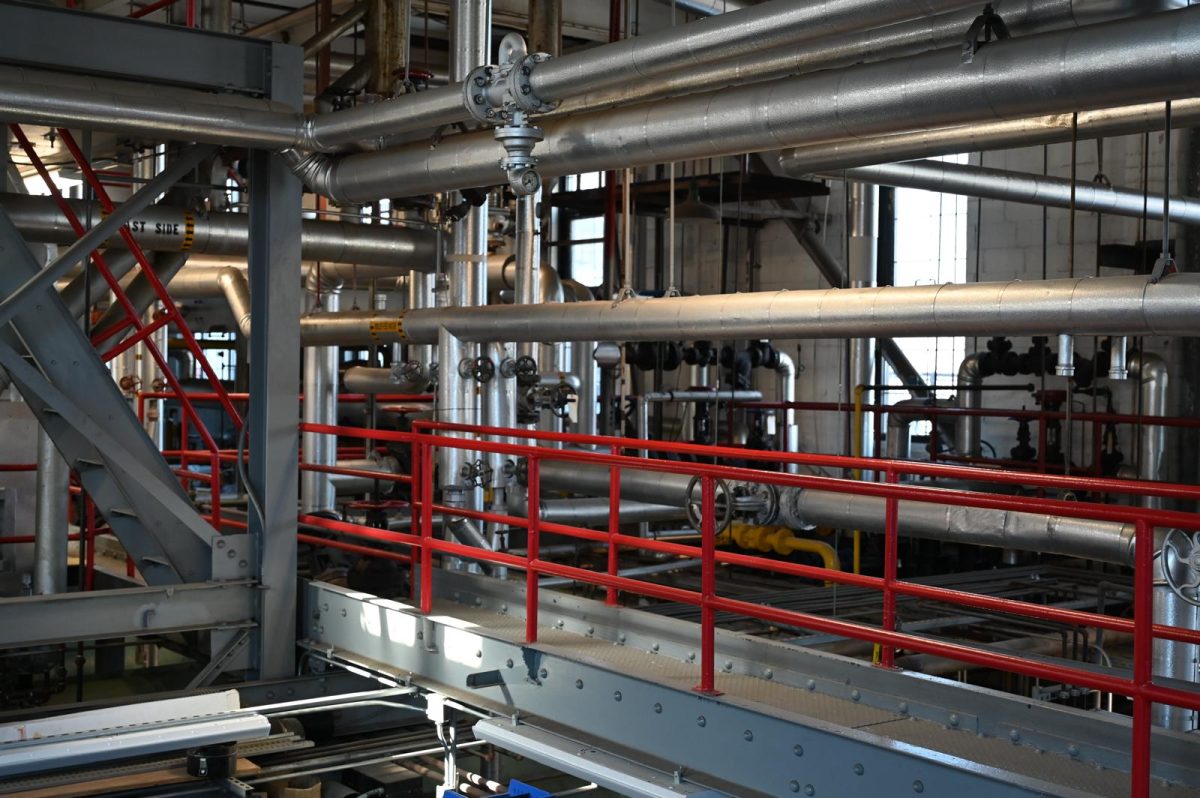
“At the crux of Lafayette being a net zero campus is the steam plant that is about roughly a quarter to a third of our annual emissions,” he said. The steam plant, which is the system used to heat the majority of campus buildings, uses natural gas for fuel and releases greenhouse gas emissions as a byproduct.
Possible alternatives might include adapting the steam plant to reduce emissions or entirely replacing it with a newer heating system, according to Amy Van Asselt, a member of the plan’s advisory committee and a mechanical engineering professor.
Jeffrey Weed, another advisory committee member and grounds supervisor, said he believes the college’s biggest challenge to carbon neutrality is the “massive investment” in infrastructure that will need to occur in the coming decade, with the college preparing for several long-term construction projects.
Updates to the plan will come a little over five years after the college’s current Climate Action Plan 2.0 was published in 2019, and 10 years after Climate Action 1.0 was headed under former college President Daniel Weiss.
“The Climate Action Plan isn’t separate individual plans,” Elliott-Knaggs said. “It is one plan that we are continually building upon and amending as circumstances, situations and technology change.”
The college committed to revising the plan every five years, following the change in the initial goal year for carbon neutrality from 2050 to 2035 during the drafting of Climate Action Plan 2.0, according to Nahman.
Upcoming sessions will be held Nov. 5-7, focusing primarily on carbon neutrality and resiliency strategies.
“This is a call to action for students and faculty and staff and our alumni and our parents and families to define what that future looks like,” Nahman said. “To inspire us and to push us to be part of the solution.”
Editor-in-Chief Elisabeth Seidel ‘26 and Assistant News Editor Makenna McCall ‘27 are employees of the Office of Sustainability. They did not contribute writing or reporting.

Paul Young • Oct 11, 2025 at 4:20 pm
So, there are colleges all across the world and all across the U.S. When Lafayette admits students whose homes are far from Easton, that inevitably leads to jet travel – one of the most GHG emitting activities there is. If Lafayette and all other schools focussed on admitting locally we could greatly reduce emissions. Has any thought been given to that in the plan?